
If everything is S-tier, nothing is. How do we decide which Pokémon deserve it?
One of our most popular types of content at Nuzlocke University is the tier list. A tier list is a great way for new and less experienced players to see at a glance which Pokémon are most (and least) effective in a particular generation, and they’re great sources of discussion for expert players too.
However, there are a few things that make putting together a Nuzlocke tier list tricky.
Challenges when tiering Pokémon
- There’s a huge variety of Nuzlocke variants – which ruleset are you using? Switch or Set mode? Are healing items allowed? Do you enforce level caps?
- How do you value a Pokémon that doesn’t evolve or learn key moves until late? What about Pokémon with huge early power spikes that don’t scale into the midgame or Elite Four?
- Is your tier list geared towards less experienced players, or towards experts with complete game knowledge who plan meticulously? Do you assume players will be researching fights beforehand? (In other words, how do you rank Pokémon who are generally weak but have specific, key moves or abilities which counter a particular opponent, but which inexperienced players will not know about?)
Examples of tiering difficulty
- Shedinja: If you understand the mechanics of its ability, research every fight, and are careful, Shedinja is literally invincible, but the player has zero margin for error – even a single mistake throughout your entire run kills it.
- Salamence (in Emerald): With incredible stats, and a great typing and ability, it’s one of the strongest possible Pokémon for the final stretch – but isn’t available until after the eighth Gym, meaning it can’t help you through most of the game.
- Onix: Terrible offensive stats mean that all you can do with Onix is tank hits and heal your other team members. This is a powerful strategy – but what if you’re playing a Hardcore Nuzlocke and can’t use healing items in battle?
These examples demonstrate the challenge of ranking Pokémon in a tier list.
- Shedinja is theoretically invincible – but will that invincibility work in practice, in the hands of a less experienced player?
- Salamence is probably the strongest non-legendary Pokémon in Emerald, so how can we justify not placing it in S-tier… but then, how can a Pokémon that isn’t even usable through the majority of the game warrant that ranking?
- Onix and other “do-nothing” tanks are great in a standard Nuzlocke where they can sit on the field taking hits while you heal up the rest of your team, but more and more players are moving towards Nuzlocke variants that ban healing items. How do we rank these Pokémon?
Before even considering people’s differing opinions and experiences, these factors alone make achieving a tier list with any sort of consensus challenging. Two players will argue over Shedinja’s placement, with one ranking it S-tier and the other ranking it D-tier, neither realizing that they are working with completely different assumptions about what type of player the tier list is for.
These questions aren’t impossible to answer, but they do require us to clarify our criteria and assumptions, or else conflicts like the above are inevitable. I hope that by laying these out clearly, we can explain why we rank Pokémon the way we do – and why we sometimes disagree with other readers, commenters, and creators.
Here are the guidelines we try to follow when building our tier lists:
Rule 1: Early Game > Elite Four > Challenging Midgame Fights > Everything Else
When conflicts arise between a Pokémon’s early, midgame, and late-game viability, this is the order of importance we generally use.
Early Game > Elite Four > Challenging Midgame Fights > Everything Else
Why this order?
- The early game is where encounters and team options are most limited, so Pokémon which handle tough early game fights have high value. (For example, Brock may be easy, but can still wipe a Charmander player without Mankey in FR/LG, which gives a big boost to Bulbasaur and Squirtle who both sweep this fight.)
- The Elite Four is usually the pinnacle of a game’s difficulty, so Pokémon which excel here will be ranked more highly, despite the greater number of available encounters and team options.
- Many games containing challenging midgame Gym Leaders or Team Boss fights, which, while not as powerful as the Elite Four, place higher demands on teambuilding than the average fight, and so Pokémon that excel in these fights are valuable.
Aside from these three, the remainder of a game’s challenges tend to be fairly trivial, but they do make up a majority of the player’s time with the game, so Pokémon which excel against random trainer fights and easier Gym Leaders still have value by preventing unexpected KOs and allowing the player to focus their teambuilding exclusively on tougher opponents.
Rule 2: We don’t penalize for rarity, but we do give bonuses for early and/or common access.
The goal of our tier lists is to help players understand which Pokémon are worth using if you obtain them, so we don’t penalize Pokémon for having low encounter rates (after all, a player who rolls Skarmory instead of Spinda in Emerald should understand how beneficial that lucky roll is, and penalizing Skarmory because of its rarity gives a confusing message to those who are lucky enough to obtain it).
However, useful Pokémon which can be reliably obtained as guaranteed or common encounters, especially early in their game, will often receive a tiering bonus to reflect the fact that they can be consistently relied upon and built around. (As an example, this is one of the factors contributing to Gyarados’ continued success – not only is it powerful, but it is almost always a guaranteed early encounter.)
Rule 3: We assume the Hardcore Nuzlocke ruleset.
In situations where the ruleset being used would affect a Pokémon’s tiering, we assume the Hardcore Nuzlocke ruleset (click the link for a description if you’re unfamiliar). There are two reasons for this.
First, our survey of readers from Nuzlocke University, the r/nuzlocke subreddit, and the Nuzlocke forums showed that the majority of respondents play with additional rules, the most common being the Hardcore Nuzlocke. We understand our survey has a sampling bias towards more hardcore Nuzlockers, but the fact remains that as Nuzlocking has matured, the Hardcore ruleset has become the most popular way to play.
Second, the Hardcore Nuzlocke represents a higher level of challenge than the basic Nuzlocke, and therefore a Pokémon’s performance under this ruleset tends to be more impactful than in the easier basic variant where a greater variety of powerful strategies can be used.
Rule 4: We generally try to approximate a normal distribution.
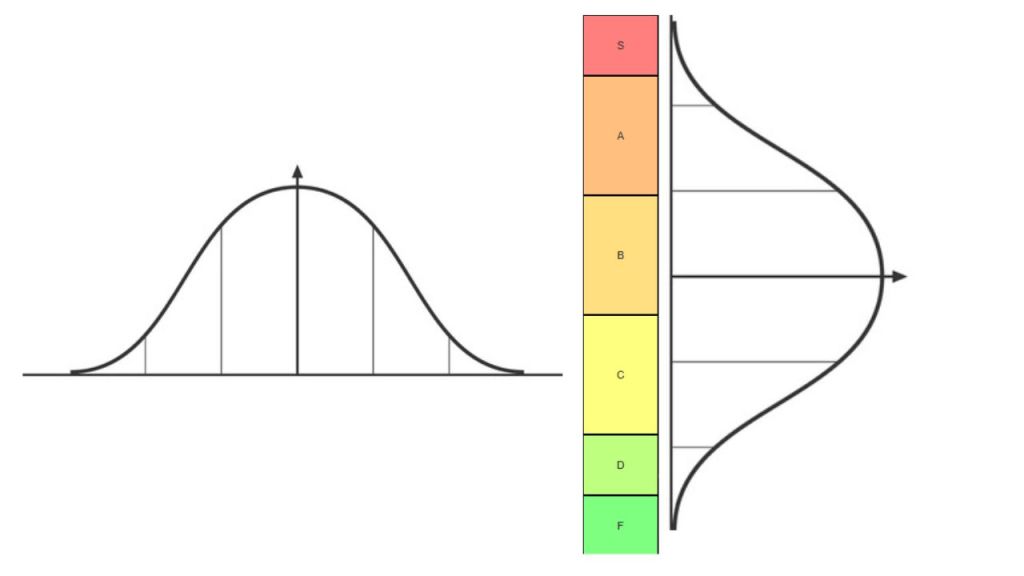
This is mostly to combat the “Tier List Creep” rampant across all corners of the internet, where, in an effort to avoid upsetting viewers by placing their favorites in a low tier, creators tend to skew their placements towards the high tiers, leading to a majority of the items/characters being ranked in S or A-tier and devaluing these rankings.
By forcing ourselves to approximate a normal distribution/bell curve, our highest (and lowest) tier rankings maintain their value. S-tier should be reserved for Pokémon which truly break a game’s power structure – in a useful tier list, the bulk of Pokémon should be centered around the B or C tier – the “normal” power level.
If everything is S-tier, nothing is.
Rule 5: We assume a Nuzlocker of average skill, who is doing a Serebii/Bulbapedia search before each major fight.
Some of our rankings may not make perfect sense in the context of an extremely skilled Nuzlocker, or in the case of a completely new player, and that’s because we assume a Nuzlocker of roughly average skill when we tier Pokémon.
We also don’t assume complete, in-and-out game knowledge, but we’re also not considering blind runs – we’re assuming a similarly “average” amount of information, what you’d get by searching a Gym Leader’s team on Bulbapedia before a fight.
This is relevant when it comes to extremely niche techs or counters that an average player will not know, and accounts for a significant amount of disagreement on our tier lists. (“How can you rank this Pokémon in only C-tier when they can completely invalidate “X” Gym Leader’s ace with “Y” TM move and “Z” ability, as long as you’ve EV-trained them for “A” speed?”)
It’s also relevant in the context of deciding which parts of a game to consider for ranking. For example, Twitch streamer and YouTuber Pokémon Challenges (pChal) recently made an excellent FireRed/LeafGreen tier list, where he states early in the video that most of the game is so easy that he will basically only be considering usefulness in the Elite Four for Pokémon rankings.
While this is a perfectly valid approach, it comes from the perspective of an extremely skilled Nuzlocker with an experienced community, whereas many new or less experienced players referring to a tier list for guidance might not be able to make the same assumption. Because this isn’t the criteria we use in our FireRed/LeafGreen tier list, and we instead assume an “average” Nuzlocker, some of our placements don’t match.
This does not invalidate either list – a reader or viewer should, however, understand that these different tier lists are being made with different criteria and different players in mind.
Rule 6: We know our tier lists won’t be perfect, so we strive to update them when necessary.
This is a disclaimer that, despite everything you’ve just read about our process, we don’t claim to be the definitive authority on all Pokémon games. As such, we don’t claim to make “definitive” tier lists, and we don’t claim that they will be accurate for all time.
While the Pokémon games themselves don’t change, community understanding of them does. New strategies are discovered, and we expect that as we play more and engage in community discussion, we’ll discover inaccuracies in our tier lists, and rather than doubling down, we will update our tier lists when sufficient changes are needed.
So there you have it – the six rules and assumptions we at Nuzlocke University use when building our tier lists. We hope this clarifies our thought process and helps to make sense of why we rank certain Pokémon the way we do.
Now that you’ve read our tier list philosophy, check out the rankings themselves at our Tier List Index, and be sure to visit Nuzlocke University for guides, articles, tips, and more Nuzlocke content.
Happy Nuzlocking!

 Nuzlocke University
3 thoughts on “The Nuzlocke University Tier List Philosophy – How We Rank Pokémon”