
Prefer to listen? This article is available in video form on YouTube!
Continue reading for the text version.
Today, I want to discuss an issue in the Pokémon Nuzlocke community I call “The Rare Candy Debate”.
I’ll explain what this debate is, what it’s all about, and where it came from, and once that’s established, I’ll go over the pros and cons of rare candies in Nuzlockes.
Now – hold on a moment.
If you’re an experienced member of the Nuzlocke community – if you’ve spent time browsing the r/nuzlocke subreddit or the Nuzlocke Forums, you may be rolling your eyes right now.
“Oh great, another discussion of rare candies. Just what we need!”
And yes, I acknowledge, this topic has been discussed to death in hundreds of unproductive and often toxic threads and forum posts – there’s been more written about this topic online than anyone probably cares to read. I understand that.
But this article is not really about whether the Rare Candy Clause is a good or bad thing, or whether you should use them – instead, it’s about why this debate is still happening, what unique elements of the Nuzlocke community have shaped the discussion, and what it shows about this community – and perhaps even other gaming communities more generally.
Now, I feel it’s important to add the classic and overused disclaimer:
Your Run, Your Rules.
We’re going to be spending some time today discussing the ways in which certain adjustments to the Nuzlocke challenge may help or hinder the overall experience. Please keep in mind that this article isn’t meant to be prescriptive – I’m not telling you how to play your Nuzlockes. Do what you enjoy, play how you want, and have fun.
Cards on the table: I normally use Rare Candies in my Nuzlocke runs, and I think it’s important to be transparent about that up front, so you understand what mindset I approach this article from.
Despite that, I’m going to try hard to present each argument fairly and in good faith, and in its strongest possible form so that a productive discussion can emerge. My hope is that players on either side of this debate will be able to read this article, understand the arguments both for and against their position more clearly, and realize why this topic seems to be such a recurring source of disagreement.
Disclaimers and preamble out of the way, let’s get started.
Part 1: Nuzlocke History: Grinding & How We Got Here
From the earliest days of the Nuzlocke challenge, grinding your Pokémon to an appropriate level had always been a core part of the experience and strategy. “Grind XP” was the most common piece of advice given to new players – including here on Nuzlocke University. Grinding your Pokémon to an appropriate level was the most reliable way to prevent unexpected deaths, and failing to do so, or entering an important fight underleveled, was one of the fastest ways to lose your run.
Not only was grinding XP an important strategy for Nuzlocke success, it was also generally viewed by the community as a core part of the unique identity and difficulty of the challenge. People would often joke that battling the same trainers or wild Pokémon over and over to prepare for a boss fight was a “rite of passage” to the Nuzlocke community, and the tedium of that activity was part of what made completing a Nuzlocke seem impressive to outsiders – at least in the early days.
However, as Nuzlocking became more popular and “matured” as an experience and a community, the difficulty of the challenge increased. This happened in two main ways – first, people began playing harder and harder “ROM Hacks” or fan games, and second, people started adding tougher and more restrictive additional rules to the core Nuzlocke ruleset.
This increased difficulty matters to our discussion in two ways.
The first is that as streamers and YouTubers started pushing the difficulty of their Nuzlockes higher and higher, the frequency of wipes and restarts increased. Grinding a whole new team of Pokémon every time they reset started to become extremely tedious, both for the player and the audience.
So, what was the solution?
Well, you probably know where we’re going with this, but to set the stage, we need to first discuss the second way this increased difficulty affected Nuzlocking, and that’s through optional rules and tougher Nuzlocke variants.
Part 2: The Overlevelling Problem & Level Caps
See, experienced Nuzlockers had started to notice that any Nuzlocke challenge could be trivialized by simply finding an efficient place to farm XP and overlevelling your Pokémon until they were well above the intended level curve for that portion of the game. This made otherwise difficult fights or sections of the game trivial, and removed much of the risk that was inherent to the identity of the Nuzlocke challenge.
Worse than just being boring, however, this strategy of overlevelling was optimal. Specifically, it’s what we refer to as a “First Order Optimal Strategy” in game design, which is, roughly speaking, when a specific strategy is so effective and requires so little skill or effort that it invalidates other strategies. This was the big problem with overlevelling – it was so effective, and eliminated so much risk, that it didn’t make sense not to overlevel if your goal was to complete your Nuzlocke run.
To fix this, a rule change was needed – which is where level caps come in. In Nuzlockes, a level cap refers to a maximum level which a Pokémon may not exceed during that portion of the game, typically the level of the next Gym Leader’s strongest Pokémon.
For most players, their first introduction to the level cap rule was in a Pokemon Challenges video in which he introduced an alternate Nuzlocke ruleset he called the Hardcore Nuzlocke, which included Level Caps, as well as banning the use of Bag items in battle and playing on Set mode rather than Switch mode.
Now, with this new optional rule, the problem of the first-order-optimal strategy of overlevelling had been addressed, but there was another side effect – this greatly reduced the importance of grinding for XP. Because your Pokémon were not allowed to exceed a certain level threshold, the value of grinding as a skill in this new ruleset was decreased significantly.
This also introduced a new puzzle-like element to Nuzlocking – by enforcing a level cap, you are restricting the possible Pokémon evolutions and moves that will be available for any particular portion of the game.
For example, if the level cap for the Gym Leader you’re facing is Level 20, and your Pokémon learns a useful move at Level 21, or evolves at Level 22, you will never have access to these moves to use in this fight, whereas before level caps, you could simply grind a bit more XP to increase your chances of winning and decrease the difficulty as far as you were willing to grind.
Therefore, for players who were using this new ruleset, the focus of the Nuzlocke challenge shifted towards a sort of “puzzle” game, where figuring out how to maximize the limited tools available was more important than the perseverance or time investment of grinding XP.
And some players started to realize that if grinding XP was no longer a skill that was central to the identity and challenge of their Nuzlockes – if overlevelling for higher stats or better moves was no longer even possible – then why spend time fighting the same wild Pokémon over and over again? Why not just save time by somehow “setting” your Pokémon to the appropriate level cap before the fight?
Part 3: The Rare Candy Clause
This, at last, bring us to the rare candy clause.
Players using this clause would allow themselves to hack infinite rare candies into their game, in order to level up their Pokémon to the appropriate level cap without grinding.
And – this is important to clarify for those unfamiliar with how the rare candy clause works – it is ONLY used in conjunction with level caps. People using rare candies in their Nuzlocke runs are not using those candies to arbitrarily level their Pokémon to Level 100 before the first Gym – they’re only raising their Pokemon to the level cap for that fight, so no unfair in-battle advantage is being gained.
Ok, so finally, we’ve established what the rare candy clause is and why it exists. Now, we can get to the rare candy debate itself.
Now, let me set the stage a little bit, because you might be asking:
“What debate? It’s an optional rule, it solves a problem some people had, what’s there to disagree about?”
But if that’s what you’re thinking, you might be surprised, and anyone who is active in the Nuzlocke community knows that this has been, and still is, a frequent topic of discussion.
Part 4: Two Games Called “Nuzlocke”
My “thesis statement” for the next section, and why I think people disagree on this so strongly, is that there are actually two, fundamentally different games people are talking about about, even though they use the word “Nuzlocke” to describe both of them.
I think this explains why we see so much disagreement about something seemingly so benign – people on either side of this argument are applying the same arguments to fundamentally different play experiences, so agreement is impossible – unless we can define our terms and understand where the disconnect is.
So, what are the two different “games” or experiences that I’m talking about here?
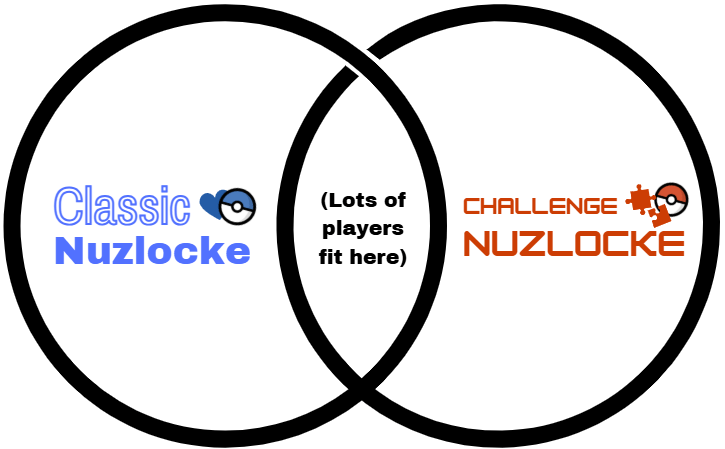
Well, Game A I’m going to refer to as the “Classic Nuzlocke” and is most similar to the original Nuzlocke comics. While I want to be careful to avoid overgeneralizing here, I feel comfortable saying that this type of Nuzlocke has a heavy focus on emergent narrative through the Nuzlocke mechanics. From this type of player’s perspective, the whole point of the Nuzlocke rules – permadeath and limited Pokémon encounters – is to organically create moments of tension and drama, and a sense of overarching narrative with their Pokémon as the main characters. Someone who plays this way probably views nicknaming their Pokémon as an essential element of the challenge.
Game B I’ll refer to as the “Modern Nuzlocke” or the “Challenge Nuzlocke”. This type of challenge is often defined by a high degree of difficulty, but not necessarily – more fundamentally, this playstyle is defined by viewing the game and its various battles as puzzles to be solved. For this type of player, the enjoyment comes from utilizing their extensive knowledge of game mechanics and content to find solutions that allow them to beat each challenge with minimal risk, given a limited set of tools and resources. These players are unlikely to consider nicknaming Pokémon a core Nuzlocke requirement, because the focus is on the mechanical gameplay rather than the narrative or emotional experience.
It’s important to note that these two perspectives on Nuzlocking are not completely binary – most people who play these games value both of these experiences, just to different degrees, and it’s those differing degrees that lead to differences of opinion regarding the use of Rare Candies.
Part 5: Pro Rare Candy Arguments
So, finally, let’s get into the actual debate. We’ll start with the arguments in favor of the rare candy clause.
Any discussion about the benefits of the rare candy clause has to start with convenience at its core. Fundamentally, the use of Rare Candies in Nuzlockes is about saving time by removing the need for repetitive, tedious grinding on wild Pokémon.
While opponents may argue that doing so makes the game easier by removing the risk that a Pokémon may die during grinding, Rare Candy users would counter that, if they wanted, they could simply go to the first route and fight Level 2 and 3 Pidgeys with no risk, until they reached the appropriate level, and therefore that grinding XP is an inherently zero-risk activity anyways, so nothing is lost by skipping it except large amounts of wasted time. For some players, this reduction in tedium makes Nuzlocking more fun, and that’s all there is to it.
For others though, this can go a bit deeper. We already discussed streamers and YouTubers earlier in this video, but if you’re tackling a super-difficult ROM Hack or restrictive ruleset, and you find yourself resetting over and over, grinding XP without Candies would not only become exponentially more time consuming, but also create a boring viewing experience. Even for non-content creators, the time constraints of grinding can make high-difficulty Nuzlockes basically infeasible.
Or consider, for example, an older player, with a job, and kids, and responsibilities – they may only get a few minutes at a time to play games, and if multiple days worth of that free time had to be spent repeatedly fighting Zigzagoons, they may simply give up on Nuzlocking entirely.
This time-saving effect has an additional benefit beyond just convenience, however – the use of Rare Candies allows players to use a greater variety of different Pokémon – which is, again, especially important in high-difficulty Nuzlockes where you may, for example, be required to create a specific team to tackle each Gym Leader.
If you encounter and catch a new Pokémon that would be a great addition to your team for an upcoming fight, but your team is Level 45 and your new Pokémon is Level 20, you may just decide that using it isn’t worth the trouble without Rare Candies.
Part 6: Anti Rare Candy Arguments
Now on the other hand, let’s take a look at some of the drawbacks of using Rare Candies.
Let’s talk about the elephant in the room first – if you’re new to this whole discussion, it’s probably the first thought that came to your mind when you started reading, and it’s probably still lurking there now – some players consider the use of unlimited rare candies to be cheating.
Even in conjunction with level caps, some players consider any run completed using Rare Candies to be illegitimate. I think this comes largely from people’s residual experiences with playing Pokémon games growing up, where levelling up the Pokémon is the “hard part”, and once you’ve levelled up enough, you win – leveling up is how the game represents you as a trainer and your Pokémon becoming stronger and more skilled. If that’s the experience you remember, it’s understandable why using infinite Rare Candies feels like cheating, especially if you weren’t aware of level caps.
I said at the start I wanted to present each argument in good faith, so I’m presenting this here as a potential reason to oppose the rare candy clause. However, let’s at least acknowledge that some players make this argument in a way that’s dangerously close to the ugly kind of gatekeeping that tends to have a negative impact on communities – not necessarily because this argument can’t have some validity when expanded upon, but because the very concept of a self-imposed, unofficial challenge run of a Pokemon game being “legitimate” or “illegitimate” is silly.
There is no “Nuzlocke Council” that prowls the subreddit and the forums, certifying people’s Nuzlocke runs, and if there were, that would be for the worse.
Even if we accept that there is such a thing as an “illegitimate Nuzlocke”, players of a self-imposed, single player game do not “owe” “legitimate” play to others. This is not a multiplayer game, where cheating ruins the experience for everyone else. Unless you’re participating in a contest or a race with other players, the rules are all self-imposed, and the point is to have fun.
I thought it was important to address that at the start of this section. We’ll be sharing some other arguments against the use of Rare Candies, some of which are adjacent to this point, but I wanted to address that first.
So, moving on.
Opponents of the Rare Candy clause will point out that, no matter how the issue is framed, there is always some element of “difficulty” that is lost when you take a game that requires grinding, and eliminate the need for that grinding.
This is where the differences between the “Classic Nuzlocke” and “Challenge Nuzlocke” playstyles that we discussed earlier start to become relevant. Proponents of the Rare Candy clause, and those who view Nuzlocking through the “Challenge Nuzlocke” lens, may be confused by this point. After all, if you view Nuzlocke difficulty as primarily being comprised of different puzzle solving challenges, in which you apply game knowledge to limited resources to beat each tough fight, then you’ll argue that the challenge is exactly the same whether you use candies or not – the Pokémon end up at the same level, with access to the same moves and abilities, just more quickly.
However, there are different types of difficulty in games.
Puzzle-solving and strategy is one type – tests of reflexes, such as in action games, are another – but tests of patience and persistence are also a legitimate form of difficulty.
Take for example, RuneScape – if you know anything about RuneScape, you know it’s fundamentally about repeating simple actions, such as clicking a rock, over and over again, in a way that’s mechanically straightforward – yet few would argue that achieving Level 99 Mining in Old School RuneScape is not difficult – purely based on the absolutely grueling test of patience that game imposes.

For opponents of the Rare Candy clause, grinding Pokémon XP to achieve the appropriate level is a part of the difficulty of the Nuzlocke challenge that can’t be so easily hand-waved away. And in response to pro-Candy players who argue that grinding is zero-risk because they could just battle Level 2 Pidgeys, anti-Candy players would ask, “Sure, you could do that, but would you? Or would you lose patience and grind at higher-level, and therefore riskier, locations?”
Most Nuzlockers prior to the rare candy clause have had the experience of losing a Pokémon due to a lapse in attention while grinding XP, and know that there is inherently some risk, even if small, when levelling Pokémon the normal way, which is avoided if Rare Candies are used instead.
Aside from this discussion of difficulty, there are also ways in which the use of Rare Candies can change the gameplay experience, specifically the “emergent narrative” element that is important to the Classic Nuzlocke.
One of the obvious consequences of using Rare Candies to level Pokémon instead of grinding is that you’ll spend less time with each Pokémon, and therefore feel less attached to them – put another way, you’re less likely to develop an organic sense of narrative around a Pokémon that has been in your party for five minutes leading up to the Gym battle, and then is immediately boxed in favor of whichever Pokémon will be artificially leveled for the next Gym.
Now, if you’re primarily a Modern or Challenge Nuzlocker, you won’t care about this, because that narrative element is secondary to the puzzle-solving element of the Gym battle which you view as the main draw of the challenge, but for players who do primarily care about narrative, this takes away from the fundamental appeal of the challenge.
In a similar sense, the ability to use a greater variety of Pokémon through Rare Candy levelling, and therefore to use a team specifically tailored to each Gym battle, means you’re less likely to have a core team of 6 Pokémon who become the “main characters” of your run, again, reducing the emergent narrative capacity of the challenge.
Now, again, more challenge-focused players might scoff at this, but I think there’s a real argument to be made here. If you look at the most popular Nuzlocke playthrough videos, such as those made by Jaiden Animations, a big part of what makes them so appealing is the characterization of the Pokémon – the way they’re assigned “personalities”.
One might be an unlikely hero in a battle that seemed doomed to fail, another might consistently fall short of expectations and be labelled a scrub only to come through in the final battle – and things like this can’t happen in the same way when you’re using each Pokémon for only one or two specific Gym fights, taking them out of the box for five minutes to power level them with Candies, clearing the fight, and boxing them until the next time they’re needed.
In this case, the tedium of having to grind XP for new Pokémon “the hard way”, and the restricted roster of Pokémon the player will therefore feel inclined to use, prevents players from optimizing the fun out of the challenge – at least, that is, the fun according to a certain type of narrative-focused player.
Part 7: Conclusion, & Why The Debate Continues
So, now that we’ve looked at the arguments for and against the Rare Candy clause, let’s come back around to the overall “point” of this article, which is to ask why this debate is still happening.
I think we’ve demonstrated clearly in the previous sections that different types of players view the issue in different ways, but I actually think that’s underselling it.
I don’t think this is just different players enjoying the same game in different ways, or having different ideas about what’s fun – I actually think there are two completely separate Nuzlocke experiences that people in the community are playing (one focused on mechanical puzzle solving and challenge, and the other focused on emergent narrative and attachment to their Pokémon) and they tend to split relatively cleanly into “pro-Candy” and “anti-Candy” sides.
This is why the debate is so persistent, and why the back-and-forths in comment sections feel so fruitless – the players of these different games value totally different elements of the Nuzlocke challenge, some of which are enhanced and made more convenient by Rare Candies, and some of which are degraded by that same convenience. Because these different camps each assume that the other is playing the same game as them – a Pokémon Nuzlocke challenge – they can’t wrap their head around the other side’s arguments.
While this particular debate about the use of Rare Candies in Nuzlockes may be, in some ways, a dead-end, discussed to death – I think it makes for a great case study to understand all sorts of communities – gaming or otherwise – in which polarization and endless disagreement have become more and more commonplace.
Just the understanding that disagreements may arise because each side has a fundamentally different model of reality from which they derive their perspectives, beliefs, and arguments, can help us be more empathetic, more persuasive, and better able to recognize when the best thing we can do is just say, “Your Run, Your Rules” and leave them to it.
Thanks for reading . If you’re interested in more Nuzlocke content, such as tier lists, guides, and thought pieces like this one, check out Nuzlocke University for more.
Happy Nuzlocking!

 Nuzlocke University
I support grinding! (Obviously young people maybe not even in their 20s)
Hell no. (Everyone after that age range)
LikeLike
One thing to note about the rare candy usage that is mechanically relevant is the EVs gained from grinding vs using rare candies. Of course, EV’s can be artificially gained via items, but depending on the game you play you can’t fully control the EVs of a pokemon without grinding.
LikeLike