
If you prefer to view the following article in video form instead, you can watch on YouTube!
Note: This is an updated and expanded version of a previous team building post from 2021, with new tips, updated examples, and visual aids.
Nothing is more important to the success of a trainer than building the right team of Pokémon, and that’s even more true in the Nuzlocke challenge.
The right team composition can make the difference between victory and defeat, and the ability to build a strong team out of random encounters is what sets great Nuzlockers apart. Anyone who’s played a Pokémon game will know some basics, such as picking lots of different types of Pokémon, but the increased difficulty and inherent randomness of the Nuzlocke challenge call for a strategic approach to assembling your team.
We’ve put together a list of team building tips and principles to help you take your run further.
1. Type synergy is the “backbone” of your team
Early on in their Pokémon journey, every player quickly learns that it’s important to carry and use a variety of different Pokémon types. We’re taught the importance of the Grass, Water, Fire triangle right away, and for many casual players their team building thoughts stop here (which is perfectly acceptable, as the mainline Pokémon games aren’t exactly known for their difficulty).

This knowledge still applies during a Nuzlocke challenge, and is usually the main factor determining which Pokémon a trainer will add to their team, but it takes on an even greater level of importance here where the margin of error in battles is so much lower. It’s a good idea to build a team around a type “core” or triangle if possible (Fighting/Dark/Psychic, Steel/Fairy/Dragon, and the aforementioned Grass/Water/Fire are all good examples since they tend to cover each other’s weaknesses). Then, use your remaining team slots to cover additional team weaknesses.
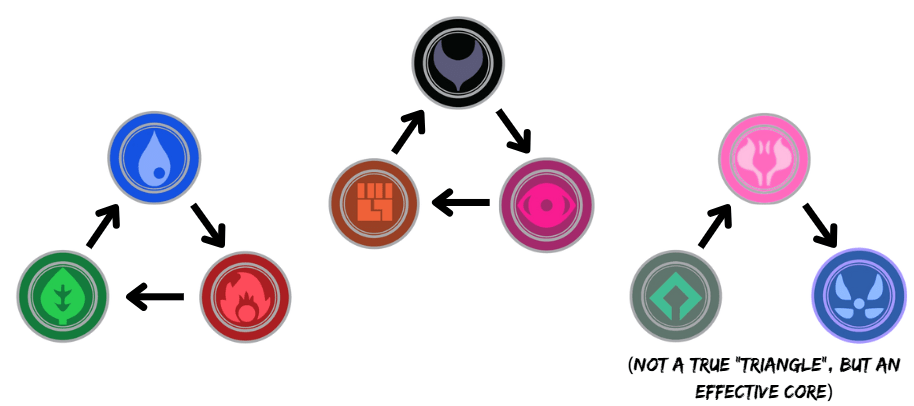
As an example, if your team is built around the classic Grass/Water/Fire triangle, then Electric types tend to make great additions, as they excel against common Flying-type Pokémon and provide redundancy against also-common Water-type Pokémon. Many common Water-types, such as Gyarados, Pelipper, and Tentacruel, take only neutral damage from Grass-type moves, so an Electric-type tends to complement this core well.
Early on in a Nuzlocke your options are limited, so you may find it hard to build a perfectly balanced team. However, as you catch more and more Pokémon later in the game your number of options increases, and you should be able to cobble together a team with types that compliment one another well, giving you an edge. Even in the Nuzlocke challenge, the most basic piece of team building advice is still one of the most important, so be sure to carefully consider the type composition of your team.
1b. Pivot Cores
A slightly more advanced way to account for Pokémon typing when team building is to assemble pivoting cores.
What is “pivoting”?
Well, pivoting is switching between multiple Pokémon in order to manipulate the opposing trainer AI into using predictable moves, which we can take advantage of. Usually, the reason for doing this is to switch in a Pokémon without taking damage. (Note that this is only relevant when playing on “Set” rather than “Switch” mode, since we don’t get the free switch when we KO a Pokémon.)
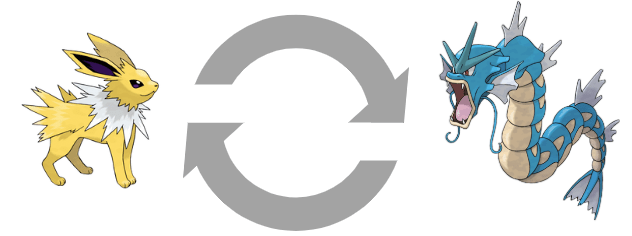
Let’s use a simplified example to demonstrate.
Let’s imagine we’re facing a Nidoking which knows only knows two moves: ThunderPunch and Earthquake. Our current Pokémon on the field is a Pidgeot, and we have Gyarados and Magneton in our party. We know that our Gyarados is faster, and can OHKO with Waterfall. However, because our current Pokémon is the Flying-type Pidgeot, we know that the opposing Nidoking will use ThunderPunch, anticipating a KO. If we switch Gyarados in, it will be knocked out by this ThunderPunch, but we’d prefer not to lose our Pidgeot either.
So how do we get this Gyarados in safely?
Well, if we first switch to our Magneton, which resists the anticipated ThunderPunch, we know that on the next turn, the opposing Nidoking will use the 4x Super-Effective Earthquake on our Steel/Electric-type Magneton, anticipating a KO. Now, we can switch to our Water/Flying-type Gyarados, which is immune to Earthquake, and KO the Nidoking safely.

By using our Pokémon’s typing and immunities to “bait” certain moves from the opposing AI, we were able to switch our Gyarados in safely, taking minimal damage.
As you can see, Pokémon with types that grant immunities, such as Ghost, Dark, Flying, Fairy, and so on, or with abilities that grant an immunity such as Levitate, make for excellent pivots. Abilities like Intimidate, which lower the opponent’s stats or provide another effect on switching in, are also nice for pivoting.
(This example demonstrates a few of the qualities that make Gyarados the best Nuzlocke Pokémon across the entire series.)
Hopefully, these two principles – type “triangles” and pivoting cores – help to demonstrate the importance of type synergy when teambuilding.
2. Build specifically for your most dangerous opponents
This tip is not relevant to those playing “blind”, but for players who are researching fights beforehand, this is the single most important thing you can do to increase your Nuzlocke success.
One of the simplest ways to carve out an advantage in a Nuzlocke is to build your team with a focus on the most threatening enemies, whether those are Gym Leaders, evil team bosses, or your rival. These opponents often present a common stumbling block to players or act as gate-keepers to further progress (for example, many beginner Johto runs have been cut short by a certain Miltank), so having a way to handle them is essential.
Good, fundamental team building using a variety of types is certainly important, but it’s not very useful to have a team with theoretically perfect type coverage if it can’t handle the Gym Leader’s toughest Pokémon. A team that can handle everything except that one rival battle is still going to wipe when you reach that fight, no matter how neatly the team is built on paper.
This is where the idea of “tech Pokémon” becomes important.
Tech Pokémon are otherwise weak Pokémon which specifically counter a particular opponent. They are useful as they can be specifically chosen to counter your opponent’s biggest threats. You can’t build for these battles if you don’t know about them, so we recommend using a database such as Bulbapedia to research the Gyms and other major battles in the game you’re playing, or you can visit our Resources page for other helpful sources of information.
Tech Pokémon may not be immediately obvious choices – they will often be found in the lower “tiers” of a tier list, so identifying the correct choices can take experience and intuition.
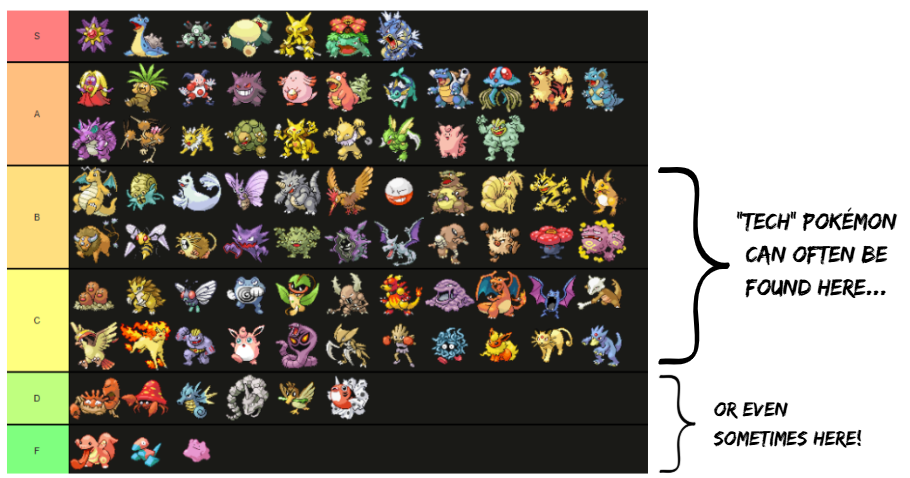
What this can teach us is that a Pokémon doesn’t always need to be “good” to be the “right” Pokémon for a particular battle.
One great example of this is in Pokémon Emerald, during the fight against Gym Leader Norman’s Slaking.
Slaking’s high base stats and threatening movepool make this a dangerous fight, made slightly more manageable by Slaking’s Truant ability which causes it to skip every other turn. Because of this, Dustox – a Pokémon with base stats that are well below the power curve at this point of the game – can trivialize this fight for one reason – it learns Protect naturally at an early level.
By using Protect on Slaking’s active turns and attacking on its Truant turns, the otherwise weak Dustox becomes the perfect answer to this difficult fight.
There are similar situations to this one in every Pokémon game, and identifying the right Tech Pokémon for each will dramatically improve your chances of success.
3. Understanding Pokémon Roles
Now, we’re moving away from planning for specific fights and back to fundamental principles of teambuilding.
Let’s discuss the different “roles” that Pokémon can take on our teams, and how to ensure that we include enough of each to cover our bases.
Now, I’m sure you could get extremely granular, go into great detail, and break this down to an almost arbitrary number of hyper-specific possible “roles”, but we’re going to discuss three broad categories today: Sweepers, Tanks, and Supports.

If you’re familiar with the “Holy Trinity” of MMO classes (DPS, Tank, Healer) then this probably sounds familiar and, indeed, the concept is similar.
First, let’s talk about Sweepers.

Sweepers are Pokémon’s “DPS” equivalent.
Their job is to enter the battle, punch big holes in the opposing team, secure knockouts, and either switch out safely or finish the battle.
The most important attributes for a Sweeper are Speed (to ensure we move first and avoid taking damage) and Attack/Special Attack (to secure KOs). Good defenses are a bonus in case something goes wrong and our Sweeper is forced to take a hit, but ideally, these Pokémon won’t be taking significant damage anyways.
For Sweepers to work effectively, they usually need two things:
- Type advantage
- A way to enter the battle safely without taking damage. (This is often achieved either by having them start the battle on the field, or through the use of pivoting like we discussed in Tip 1.)
Especially in lower-difficulty or vanilla Nuzlockes, Sweepers tend to be the most important role on a team – in a standard FireRed or LeafGreen Nuzlocke, for instance, your team may actually consist of six Sweepers, of which you select the most appropriate for any given fight. Even in higher-difficulty runs, it isn’t uncommon to see three or four Sweepers form the backbone of a team.
When given the appropriate conditions and setups, Sweepers are the Pokémon who finish fights.
Next, let’s talk about the Tank.

For Tanks, high defensive stats and HP and good defensive typing are the most important qualities.
The Tank’s job is often to act as a stabilizer or “panic button” that the player can bring in when things start to go sideways – we expect that we can switch them in to stall or survive a few turns while we get back in the fight.
Tanks will often bring some offensive presence, either through their own damaging moves, or through indirect damage source such as Toxic or Leech Seed. This allows us to play creatively around dangerous opponents when our Sweepers can’t finish the job alone.
Tanks will sometimes act as “pseudo-pivots” – they may not have an immunity to an anticipated attack, but they may be able to resist it – or simply tank it through sheer defensive stats alone – and bring in our Sweeper.
We should also note that if you’re allowing the use of healing items from the Bag, your Tank can sit on the field and absorb damage while you heal up the rest of your team, although this isn’t relevant in Hardcore Nuzlockes or other rulesets which restrict healing.
Finally, let’s discuss the Support.

The Support in Pokémon is a more ambiguous role than in other games, such as MMOs, because of the relative lack of direct healing other party members. Healing does exist – moves like Wish can be used to restore party members/ HP – but doing so safely is often difficult.
Because of this, the Support will often take a more indirect role.
Sometimes, this role will be to set up hazards, such as Stealth Rock, Spikes, or Sticky Web to enable our Sweepers; other times they’ll take the role of a specialized pivot, whose particular immunities and resistances can be used to bring in other Pokémon safely.
Alternatively, they may simply use status-inducing moves or stat manipulating moves (such as Thunder Wave to paralyze, Will-o-Wisp to burn, or Growl to lower Attack) to make it safer for our other Pokémon to enter the battle and do their jobs effectively.
How many of each role?
While the specific ratio of Sweepers/Tanks/Supports will depend greatly upon your particular team and the challenges you’re facing, some generally common setups are:
- 3 Sweepers, 2 Tanks, 1 Support (or 1 Tank, 2 Supports)

- 4 Sweepers, 1 Tank, 1 Support

4. Redundancy
Redundancy is, simply, having a backup plan built-in at the level of teambuilding – having multiple Pokémon which can perform any given role – so that if something goes wrong and one of your important Pokémon is KO’d, another can fill that role and prevent a wipe.
With this in mind, it’s not always a bad thing to have type overlap, especially for common and useful type such as Water.
During a long Nuzlocke run, it’s inevitable that at some point, a battle will go sideways, and if at that point our team has no built-in redundancy, they rest of our game plan can crumble.
Now, at this point you may ask:
“Sure, redundancy sounds nice, but I only get six Pokémon, and I need them to fulfill a variety of different roles. How can I achieve redundancy without sacrificing versatility?”
The answer to that question is our next tip…
5. Role Compression
Role compression refers to a Pokémon’s ability to perform multiple functions effectively, “compressing” multiple roles into a single team slot.
Trying to define these specific “functions” can get extremely granular, but to illustrate, let’s use the Sweeper/Tank/Support framework we discussed earlier.
Generally, a Pokémon which can perform multiple of these roles (Sweeper + Tank, Tank + Support, or Sweeper + Support) will have additional value, as combining these functions allows us to cram more function into our limited six team slots.
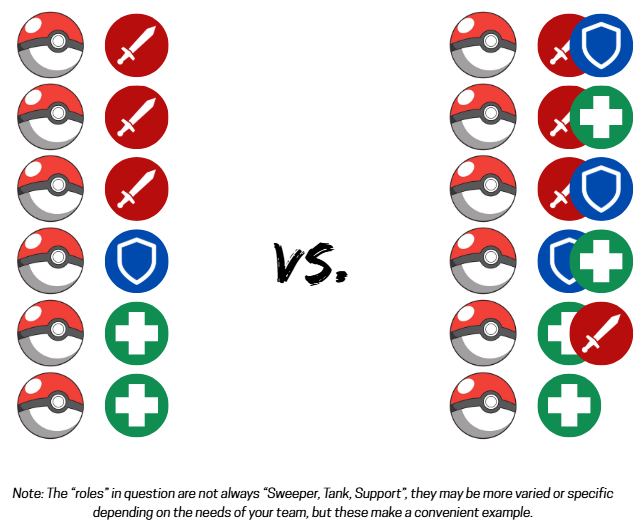
Role Compression enables Redundancy.
Summary
There you go – five Nuzlocke team building principles for you to keep in mind on your next run. See below for a quick summary/reminder:
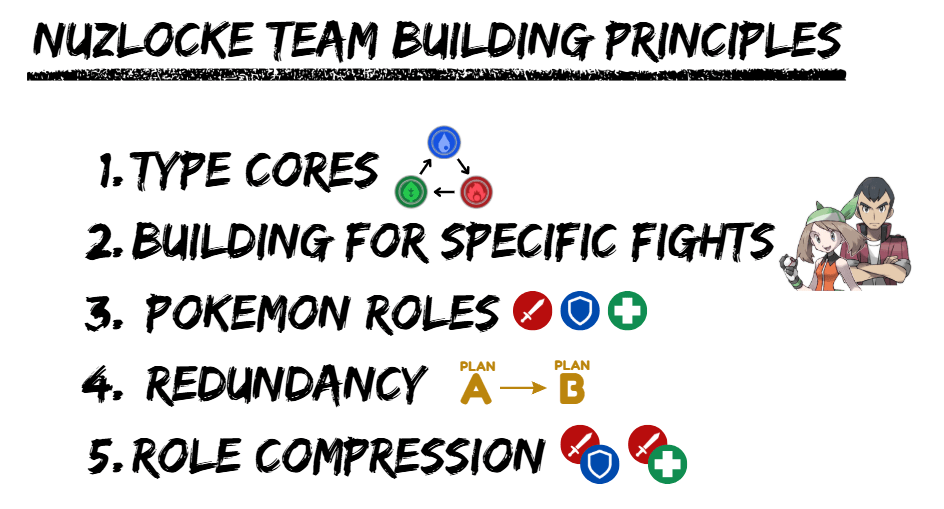
I hope you found these Nuzlocke team building tips useful! For more Nuzlocke content, check out Nuzlocke University, where we regularly post new tier lists, guides, and articles like this one.
Thanks for reading, and Happy Nuzlocking!

 Nuzlocke University